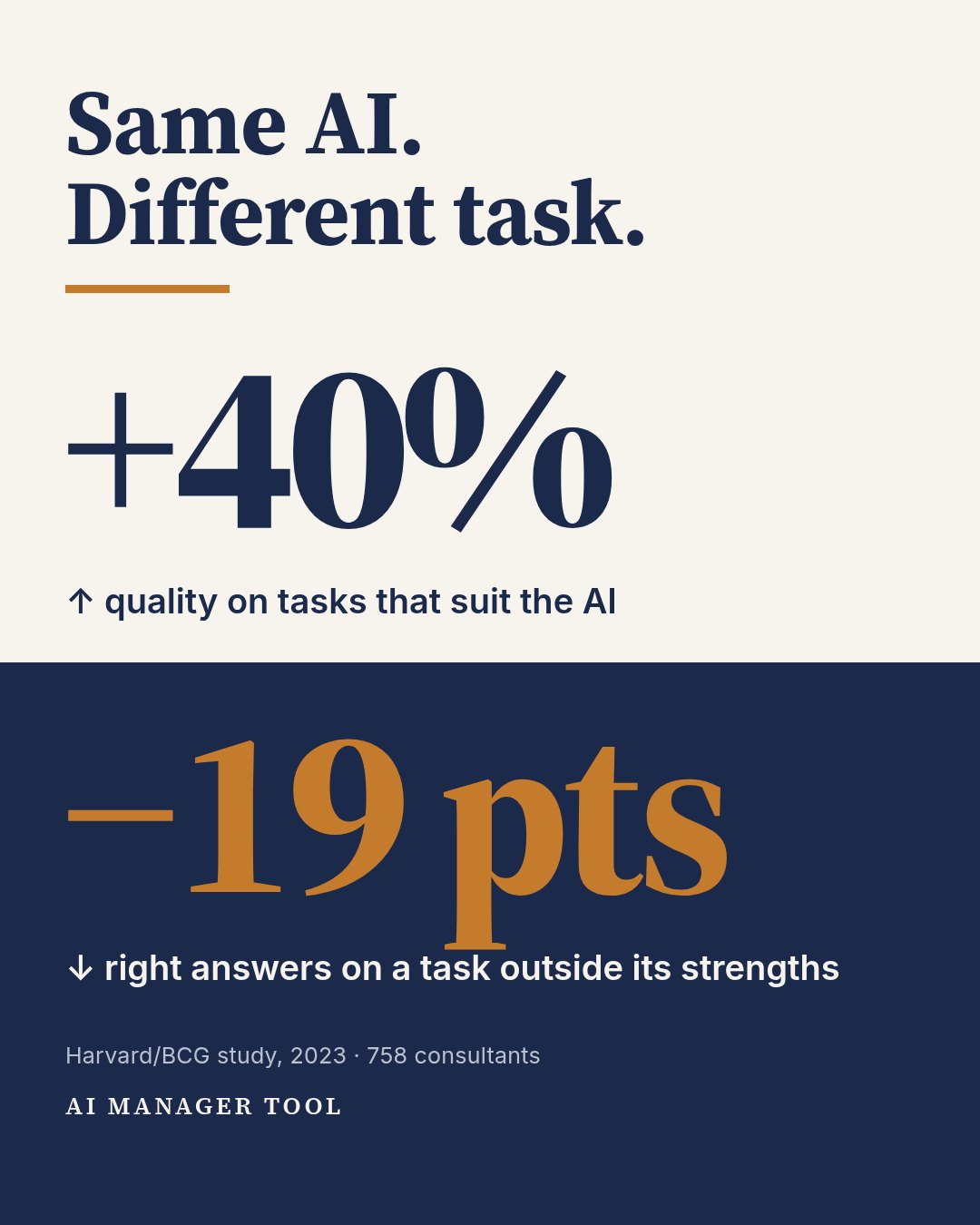
On tasks that suit it, yes. In a Harvard Business School and BCG study of 758 consultants, those given GPT-4 were 25% faster on tasks that suited the AI, and their work was more than 40% higher in quality. On a task just outside its strengths, they were 19 points less likely to get the right answer. Same AI. Different task.
What the study measured
Harvard Business School and BCG ran a field experiment with 758 BCG consultants. Some were given GPT-4, and the researchers measured speed and quality on realistic consulting tasks. The paper is Dell’Acqua et al., Navigating the Jagged Technological Frontier (2023).
| 25% | faster on tasks that suited the AI |
| 40%+ | higher quality on those same tasks |
| −19 pts | less likely to reach the right answer on a task just outside the AI’s strengths |
Why the edge is hard to see
The tool did not change between the tasks. The task did. And from the inside, the edge was not obvious: an answer from outside the AI’s strengths reads as confidently as one from inside them. That is why a team can become faster and confidently wrong with the same tool.
What this means if you lead a team
“Use more AI” or “ban it” is the wrong debate. The leadership work is knowing where the tool is strong for your team, and keeping your own judgment in charge where it is not. That is the people side of being an AI manager. Map the team’s recurring tasks once, then decide per task.
Before acting on an answer from a task at the edge, run a second pass that looks for what could be wrong.
Seven tools, one good use each
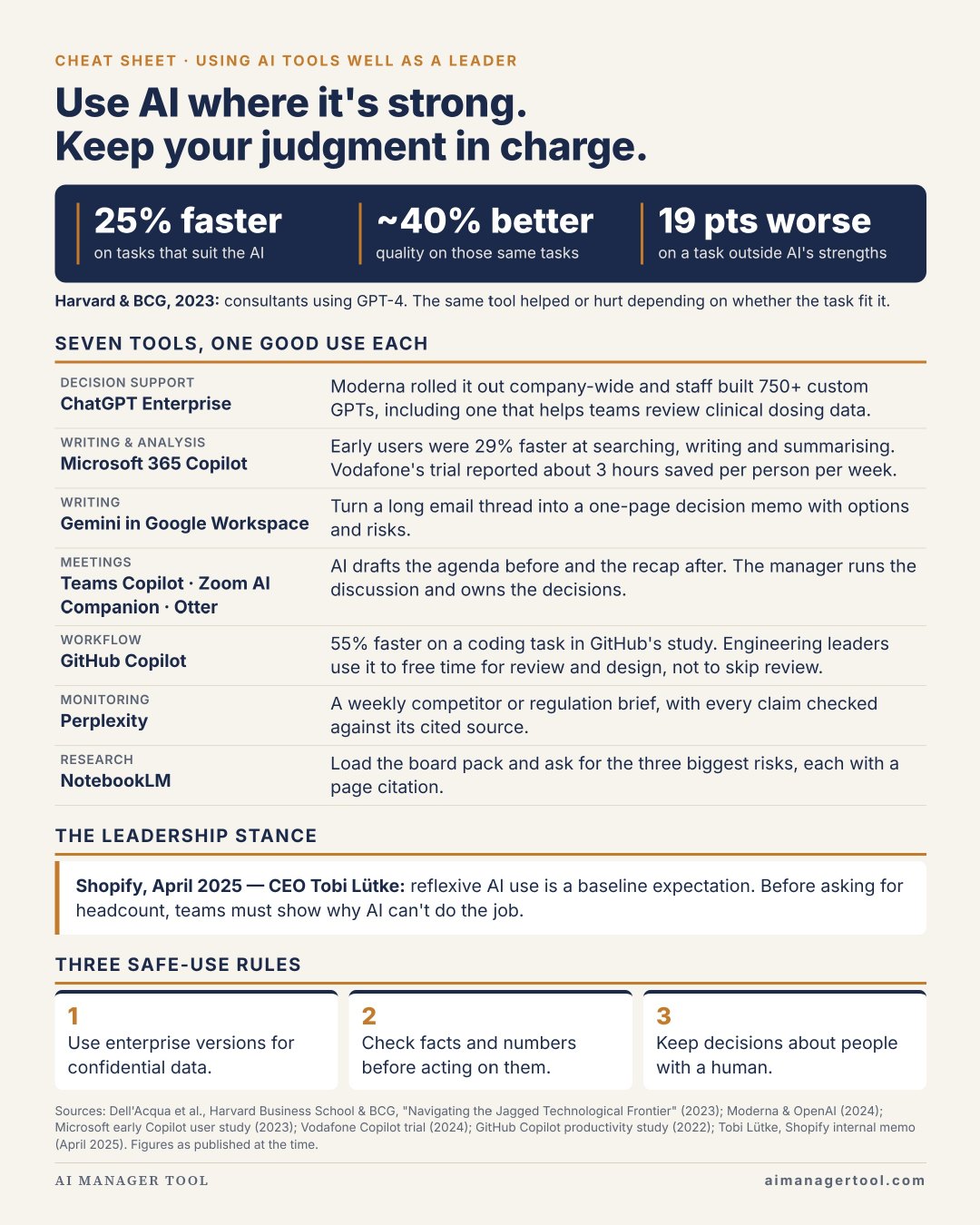
The one-pager pairs the study with seven tools and one good use for each. For a ranked view, see the top 5 AI tools.
- Decision support: ChatGPT Enterprise. Moderna rolled it out company-wide and staff built 750+ custom GPTs, including one that helps teams review clinical dosing data.
- Writing and analysis: Microsoft 365 Copilot. Early users were 29% faster at searching, writing and summarising. Vodafone’s trial reported about 3 hours saved per person per week.
- Writing: Gemini in Google Workspace. Turn a long email thread into a one-page decision memo with options and risks.
- Meetings: Teams Copilot, Zoom AI Companion, Otter. AI drafts the agenda before and the recap after. The manager runs the discussion and owns the decisions.
- Workflow: GitHub Copilot. 55% faster on a coding task in GitHub’s study. Engineering leaders use it to free time for review and design, not to skip review.
- Monitoring: Perplexity. A weekly competitor or regulation brief, with every claim checked against its cited source.
- Research: NotebookLM. Load the board pack and ask for the three biggest risks, each with a page citation.
Three safe-use rules
- Use enterprise versions for confidential data.
- Check facts and numbers before acting on them.
- Keep decisions about people with a human.
The stance is moving at the top too. In an April 2025 memo, Shopify CEO Tobi Lütke made reflexive AI use a baseline expectation: before asking for headcount, teams must show why AI cannot do the job.
Try it this week
- List 5–10 recurring tasks from your team’s last two weeks.
- Run the first prompt and mark each task inside, at the edge, or outside.
- Pick one task inside the AI’s strengths and use it there this week.
- For one task at the edge, run the second prompt before anyone acts.
What to tell the agent, and what to keep out of it, is the subject of the week 2 note, What the agent is allowed to know. One manager task per week, with the same rule, is in the weekly notes.
Free kit
Get the free AI kit for managers: one-page tools you can use this week. AI prepares, you decide.
FAQ
Does AI make every task faster?
No. In the Harvard Business School and BCG study, the gains held on tasks that suited GPT-4. On a task just outside its strengths, consultants using it were 19 points less likely to get the right answer.
Should managers ban AI or push the team to use more of it?
Neither, as a rule. Map which of your team’s tasks suit the tool, use it there, and keep human judgment in charge where it does not fit.
How do I know if a task is outside AI’s strengths?
You often cannot tell from the output alone, because confident answers look the same either way. Check facts and numbers against a source before acting, and keep decisions about people with a human.
Comments
No comments yet. Be the first to leave one.